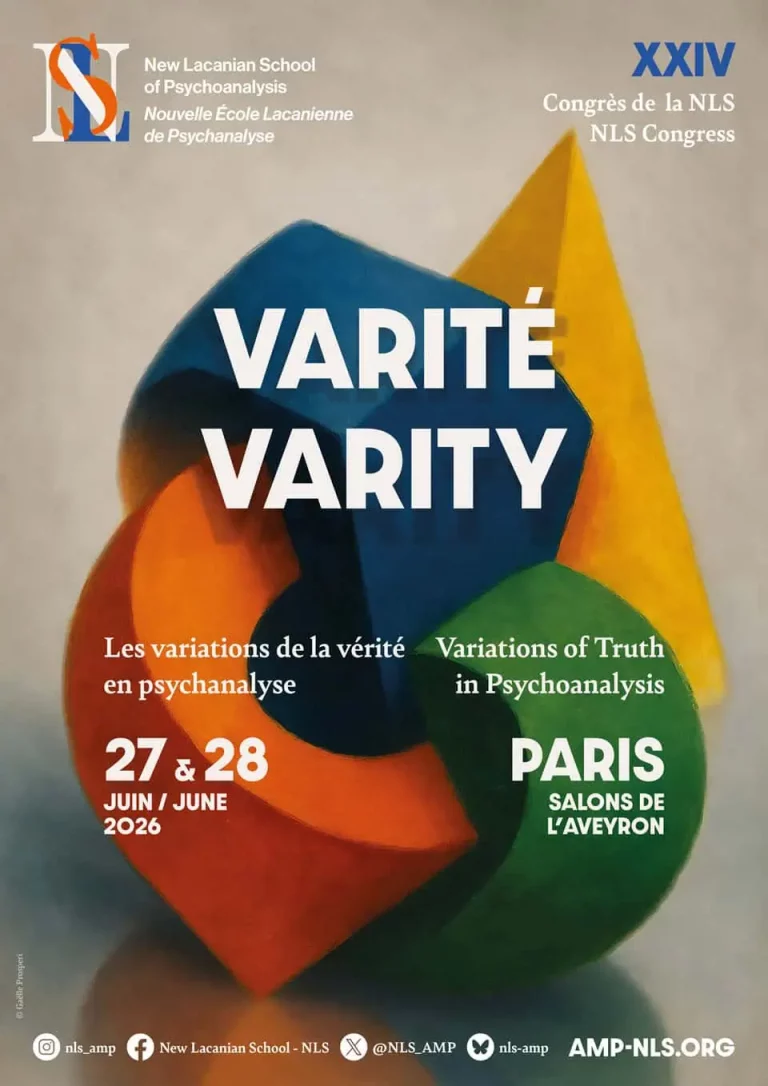
Varité — Les variations de la vérité en psychanalyse

Varité — Les variations de la vérité en psychanalyse

Varity is not relativity

By Vesselin Somlev

Psychoanalysis does not renounce universality; it relocates it. What is abandoned is the idea of a truth, reducible to a unified meaning. Truth appears only in speech, and speech is divided. Hence truth can only be half-said.[1] The limit is not a condition of language but its effect.

Universality therefore shifts from content to structure. A universal statement in analysis names either an impossibility or a condition without form. This allows truth to vary without becoming relative. Varité does not represent deviation from a whole, but a mode in which truth appears once structural incompleteness is acknowledged.

Two propositions clarify this logic. There is no sexual relation” states a universal impossibility: no signifier writes the relation as proportion.[2] Every speaking being is affected by jouissance” states a universality without common measure. Jouissance concerns the body marked by language and remains singular. Universality subsists, but without sameness.

The not-all formalizes this structure.[3] A field may be universally conditioned without being collectively completed. Truth follows this regime: it holds for all only as what cannot be said entirely. What emerges in analysis—lapsus, dreams, symptom—does not confirm knowledge but punctures it. Each articulation is local and transferential.

The law and the signifier operate universally, yet truth appears where this universality fails for a subject. The symbolic order functions for all, but the symptom marks the point at which the law fails to regulate jouissance. A symptom is therefore not an individual example of a general rule; it is the truth of a mismatch between the rule and the body.

Because saying-all is impossible, truth involves semblance.[4] What analysis produces is not adequation but construction: a saying that borders a hole in knowledge. The real is approached only through partial formulations. Each new articulation may overturn the previous one without abolishing it.

Thus, universality persists as constraint: language affects every speaking being, yet never in the same way. Varité designates this regime in which truth holds for all only through singular occurrences.

  1. Lacan, J., Television, trans. D. Hollier et al., New York/London: Norton, 1990, p. 3.
  2. Lacan, J., The Seminar of Jacques Lacan, Book XX: Encore, ed. J.-A. Miller, trans. B. Fink, New York/London: Norton, 1998, p. 12.
  3. Ibid, p.7.
  4. Lacan J., The Seminar of Jacques Lacan, Book XI: The Four Fundamental Concepts of Psycho-analysis, ed. J.-A. Miller, trans. A. Sheridan, England: Penguin, 1979, p. vii.


Latest posts

Lastest texts

The Game as a Semblant in Life Is Beautiful

Aliki Patera

A Discourse Without Truth

Yaron Gilat

The Sinister Encounter with the Truth

Yannis Grammatopoulos

Not-all Facts

Renata Teixeira

The theme

towards the nls site

links