
In Constructions in Analysis[1], Freud forges a link between historical truth and psychosis. The delusional conviction characteristic of psychosis, he argues, derives its force precisely from an infantile source. Were the analyst to attend to this dimension—rather than persisting in the futile effort to persuade the patient of their estrangement from reality—analytic work could begin on shared terrain: the recognition of a common “kernel of truth”.[2] For Freud, analysis with the psychotic subject entails a temporal displacement: disentangling the fragment of historical truth from its distortions and present-day referents and restoring it to its proper place in the past.[3]
Lacan will go further in his elaborations on psychosis in Seminar III.[4] There he locates another kind of truth in the text of the delusion.[5] This may be one reason why he grants such decisive weight to Schreber’s text in shaping Seminar III on psychosis. Lacan: “That Schreber was exceptionally gifted, […] at observing phenomena of which he is the center and at searching for their truth, makes his testimony incomparably valuable.“[6]
While there is a truth in the delusional text itself, Lacan will tell us that in delusional speech “the Other is truly excluded, there is no truth behind, there is so little truth that the subject places none there himself, and in the face of this phenomenon, […] his attitude is one of perplexity.“[7]
Lacan, in the same seminar, introduces the term “Truth of the thing“[8], which resonates with what he elaborates in The Freudian Thing.[9]
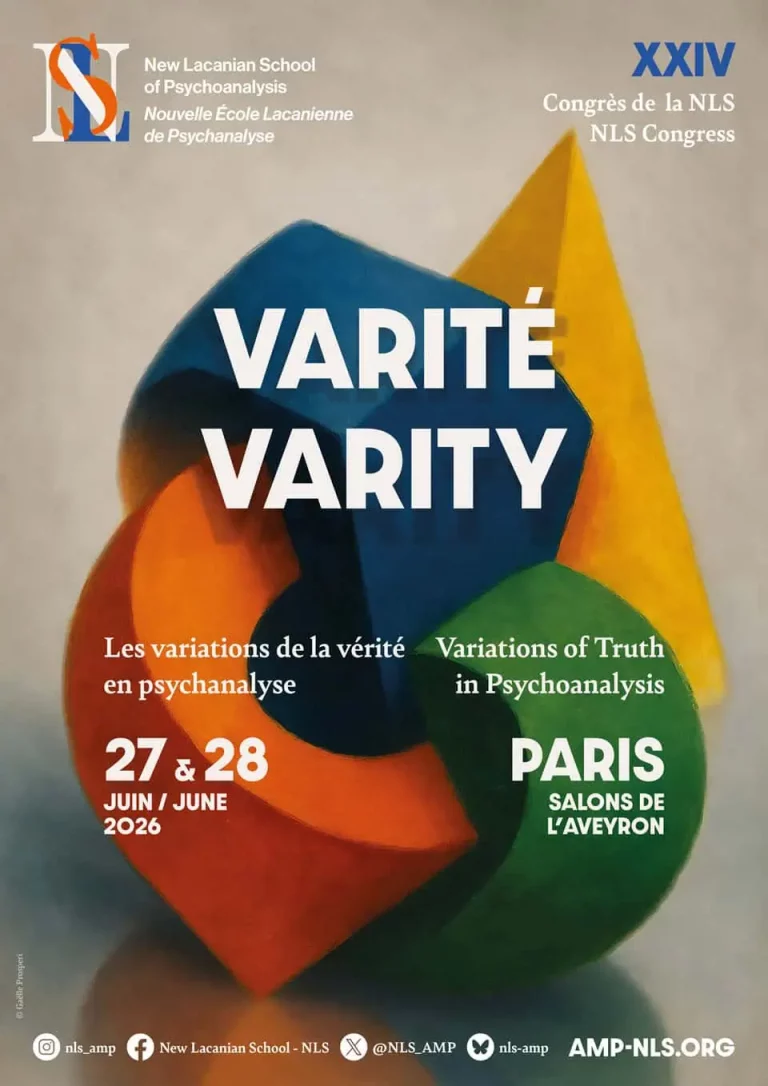
To connect the truth to the thing underlines the impossibility for there to appear The truth, and opens the path for varity, giving weight to Patricia Bosquin-Caroz’s[10] statement, that the analysand doesn’t say the truth but rather the vari(e)ty of the sinthome..
- Freud, S., “Constructions in analysis” (1937). The Standard Edition of the Complete Psychological Works of Sigmund Freud Vol. XXIII, London: Hogarth Press,1961, pp. 255–269. ↑
- Ibid., p. 268. ↑
- Ibid. ↑
- Lacan, J. The Seminar of Jacques Lacan, Book III, The Psychoses: (1955–1956). ed. J.-A. Miller, trans. R. Grigg. New York/.London: Norton & Co., 1993. ↑
- Ibid., p. 28. ↑
- Ibid., p. 206. ↑
- Ibid., p. 53. ↑
- Ibid., p. 204. ↑
- Lacan, J. “The Freudian Thing, or the Meaning of the Return to Freud in Psychoanalysis.” Écrits, The First Complete Edition in English, trans. B. Fink, Norton, 2006, pp. 334–363. ↑
- Bosquin-Caroz, P.,“VARITY. Variations of Truth in Psychoanalysis”. Argument for the NLS Congress 2026., p. 1. ↑