Varité — Les variations de la vérité en psychanalyse

Varité — Les variations de la vérité en psychanalyse

The Monster … of truth

By Archontoula Moraki


What is this truth without which there is no way of

distinguishing the face from the mask, and apart from

which there seems to be no other monster than the labyrinth itself?[1]

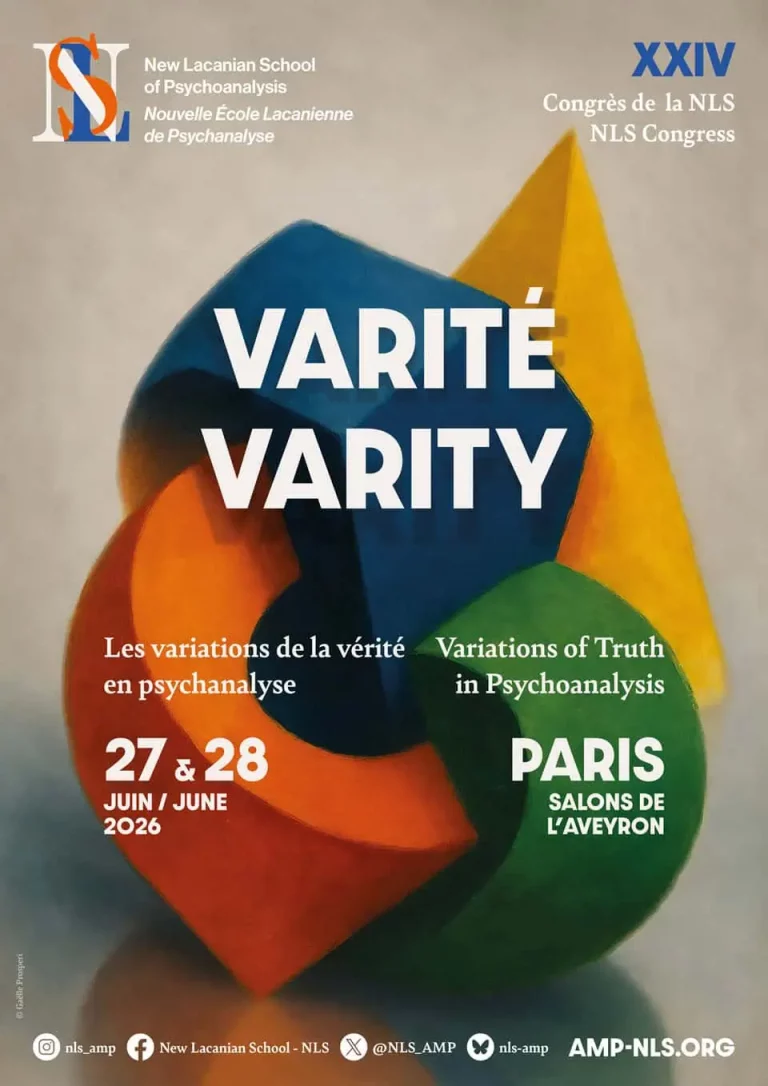
Lacan’s neologism varité[2] — the signifier that prevails in the title of the forthcoming NLS Congress — is aptly represented in Hirokazu Kore-eda’s film Monster.

Monster unfolds as a multifaceted narrative. The same story is presented from the perspective of three main characters, each shifting the viewer’s gaze towards a different aspect. At the end of each variant of the story, we believe in the truth of what has been said until the next, which via new signifiers, subverts the previous version, revealing a labyrinth of half-truths and lies.

The first variant introduces a mother who suspects her son is being bullied by his teacher. Who is the monster?” the child softly sings as he wanders alone, leading us to the teacher, who offers a different view of the events. He realises that the boy is not the victim, but the bully who intimidates a younger classmate.

Both versions show that both the mother and the teacher, are trapped within their own fantasy, remaining blind to the boy’s subjective position. They understand all too quickly. While we realise how the teacher constructs his truth, what escapes us is revealed when events are replayed from the perspective of the boy himself and his little friend. Each variant could thus function as a development of truth, when the subsequent one assumes the status of a dialectical reversal, if we follow Lacan’s reading of the Dora case.[3]

Monster echoes Lacan’s warning in Seminar III: Beware those who say to you — You understand. It is always so as to send you somewhere else than where it is a question of going”.[4] Indeed, at the very moment we think we understand, when the truth seems finally to unveil itself, we are confronted with the fundamental misunderstanding”[5] that lies at the heart of fabricating our truth as one and absolute.

In Monster, as in the psychoanalytic experience, narrative discontinuity puts the idea of a single, univocal truth in question again”.[6] We are witnessing how a truth is constantly changing, whether it is the one we weave as spectators or the one lived by the characters. The school principal’s words what actually happened doesn’t matter” echo what Jacques-Alain Miller notes, that the very articulation of the analytic discourse leads the analysand to construct, to weave a grid of a lying truth, of a variable truth, of a truth that incessantly tips over into a lie”.[7]

There is no last word in final scenes of Monster, no catharsis is granted to bring the viewer closer to the ethical dimension of the subjects’ relationship to truth and speech.”[8] The boys’ last words underscore this dimension, crucial in an analysis, where the objective isn’t to discover the truth but to find the passion to speak truly.[9]

Were we reborn?”
No, we’re still the same.”

What does it mean to be the same when a truth comes forth or even changes?

  1. Lacan, J., The Freudian Thing”, Écrits, trans. B. Fink, New York/London: Norton, 2006, p.406.
  2. Lacan, J., The Seminar of Jacques Lacan, Book XXIV: L’insu que sait de l’une-bévue s’aile à mourre, lesson of 19th April 1977, unpublished.
  3. Lacan, J., Intervention on Transference”, Écrits. op.cit. pp..176–189.
  4. Lacan, J., The Seminar of Jacques Lacan, Book III: The Psychoses, ed. J.-A. Miller, trans. R. Grigg. New York/London Norton, 1993, p.67.
  5. Ibid., p. 29.
  6. Bosquin-Caroz, P., Varity. Variations of Truth in Psychoanalysis. Presentation of the NLS Congress Theme 2026, p.7. Available at: https://www.amp-nls.org/wp-content/uploads/2025/07/ARGUMENT-NLS-CONGRESS-2026-PBC.pdf
  7. Miller J.-A., The Lying Truth”, The Lacanian Review 7, 2019, p.153.
  8. Bosquin-Caroz, P., op.cit.
  9. Miller J.-A., Pass Bis”, Psychoanalytical Notebooks 17, 2007, p. 100.


Latest posts

Lastest texts

Surprised Truth

Frank Rollier

Assumption of the Truth in Hamlet

Samya Seth

Shame, A Sign of Emptiness

Sanem Guvenc

Historicization in the Light of Varity

İbrahim Şahin ATEŞ

The theme

towards the nls site

links