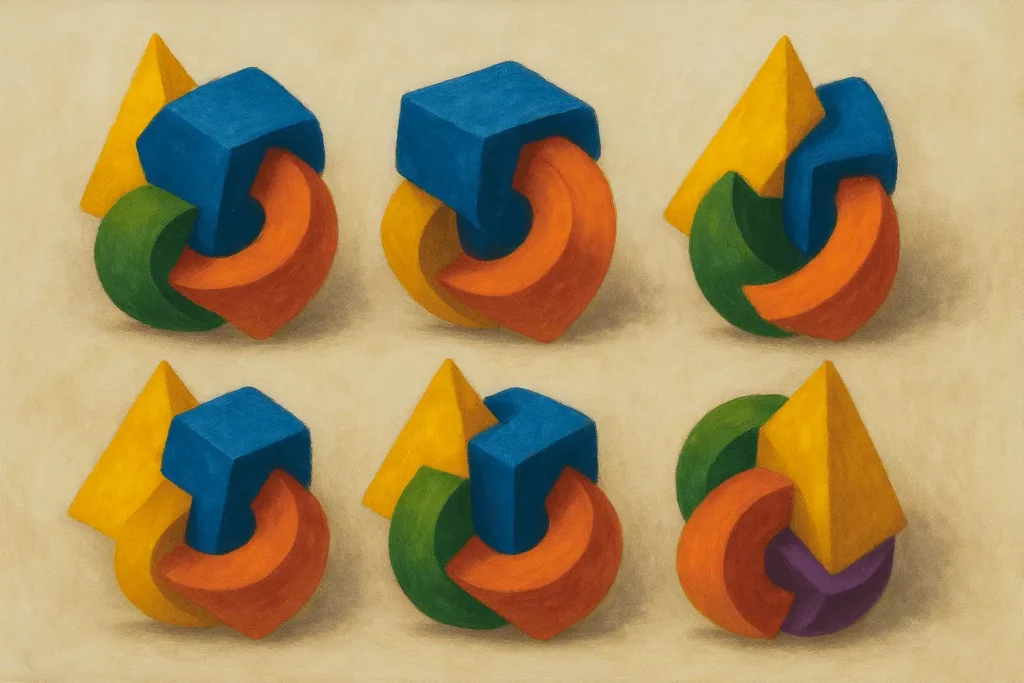
“[I]t is within this opposition between fiction and reality that is to be found the rocking motion of Freudian experience”
(Jacques Lacan, Seminar VII, p.15).
The Failure of Fiction
The demand for analysis often appears when the story we tell about ourselves ceases to convince. Early Lacan speaks of “the ego [as situated] in a fictional direction that will forever remain irreducible.”[1] It is when the ego is experienced as a fiction that our imaginary consistency is disturbed enough to seek an analyst. Yet fiction also calls to be read, prompting us to speak under transference in search of a truth beyond fiction.
The “rocking motion of Freudian experience” can thus begin when one is rocked by an experience of the fictional status of reality.
The Necessity of Fiction
Analysis can remain entangled in an imaginary truth-fiction opposition: we hope analysis will remove fiction-as-illusion so truth’s variations can come to an end.
Yet psychoanalysis “brings us up against the reality of what is neither true nor false.”[2] When Lacan says, “truth has the structure of fiction […] the term fiction does not represent anything illusory.”[3] In fact, fictions are essential for broaching a real beyond what is sayable of truth and falsity. Just as Levi-Strauss showed that myths cover contradictions constitutive of social structures, so the neurotic’s “individual myth” covers the sexual non-rapport. Reading such fictions can reveal a real of structure.
But the rocking motion of the Freudian experience goes further: fiction becomes “the lying truth,” since “language is a semblant and regarding the real, it can only lie.”[4]
The Theory of Fictions
Lacan’s key reference here is not literature but Jeremy Bentham’s Theory of Fictions. In Bentham’s work, there is also a “rocking motion” between two theories of fiction.
The first was an Enlightenment-style polemic against deceptive “legal fictions”, which sustained an extra-linguistic notion of truth as measurable exactitude. At this point, Bentham’s distinction between “real” and “fictitious entities” aimed at a reality outside fiction.
But his utilitarian investigation into the “twin masters of pleasure and pain”[5] went further. His second theory presented fictions not as deceptive but as indispensable to the beings of language we inescapably are. “Logical fictions” became inherent to discourse and rooted in truths about the enjoying and suffering body.
If Lacan promoted Bentham to an antecedent of Freud, it is because this second theory resonated with what Freud wrote to Fliess in 1897: “there are no indications of reality in the unconscious…one cannot distinguish between truth and fictions cathected with affect.”[6]
- Lacan, J., “The Mirror Stage as Formative of the I Function”, Écrits, trans. B. Fink, New York: Norton, 2006, p. 76. ↑
- Lacan, J., “The Function and Field of Speech and Language in Psychoanalysis”, Écrits, trans. B. Fink, New York: Norton, 2006, p. 212. ↑
- Bosquin-Caroz, P., “Varity. Variations of Truth in Psychoanalysis”, Presentation of the NLS Congress Theme, 2026, p. 6.Available at: https://www.amp-nls.org/wp-content/uploads/2025/07/ARGUMENT-NLS-CONGRESS-2026-PBC.pdf ↑
- Ibid. ↑
- Bentham, J., An Introduction to the Principles of Morals and Legislation, Oxford: Clarendon Press, 1823, p.1. ↑
- Bosquin-Caroz,P. “Varity. Variations of Truth in Psychoanalysis”, op.cit., p.2. ↑