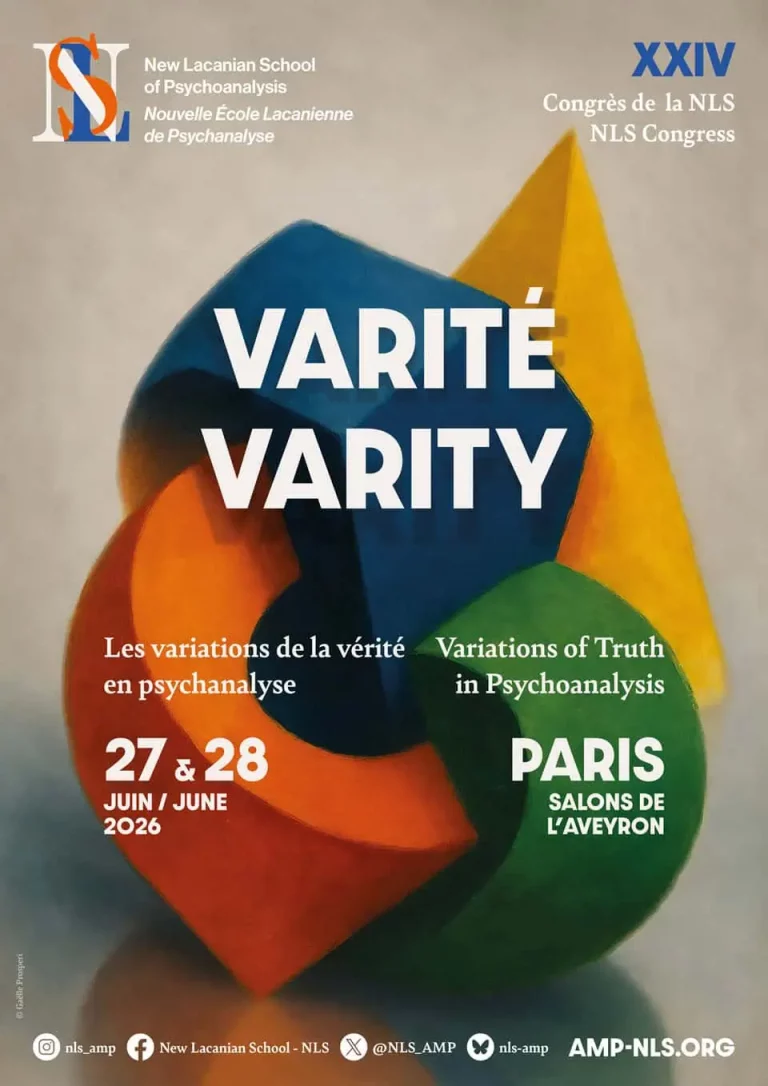
Varité — Les variations de la vérité en psychanalyse

Varité — Les variations de la vérité en psychanalyse

No truth without fiction in The Writer in the Family

By Nina Todorova

In 1955 my father died with his ancient mother still alive … Thinking the shock might kill her, my aunts told her that he had moved to Arizona … After the end of our mourning, Aunt Frances phoned. You’re the writer in the family. Would you mind making up something? I’ll read it to [mama]. She won’t know the difference.’ That evening, I pushed my homework aside and composed a letter.”[1]

What begins as a fabrication meant to protect the family’s sensibilities becomes a mode of knowing.[2] Through writing, the adolescent constructs an account of his father’s attachments and longings. Raw experience and family tensions are reshaped into half-truths.

If narration sustains continuity, is there meaning prior to the storytelling?[3] Truth is coupled with meaning,” writes Jacques-Alain Miller, and the two of them make a trio with fiction.[4] The young writer produces a new version of his father’s desire, one that corresponds to his own wishful illusions.”[5] A personal truth?[6]

At first, the letters satisfy the family’s demands. But as grief and expectation weigh more heavily on him, the writer is plagued by nightmares. In his dreams, his father – no longer the strong man he once was, but ill and suffering — refuses to return home from the hospital, insisting on being left alone.

Then comes a surprise: his father had once been in the navy, something the boy never knew. As he contemplates an old photograph of the sailor on a dimly lit night, he catches a glimpse of a gift from his father — a set of Great Sea Novels and a telescope — which now take on new significance. The final letter from Arizona reads: Dear Mama, I have been told by the doctors that I am dying of the wrong life … I should never have come to the desert. I have asked Ruth and the boys to have my ashes scattered in the ocean.”[7]

Writers, too, are driven by a passion to reorder the semblant.[8] They work at the edge of language, where truth is always in the making. E.L. Doctorow compares writing to driving at night in the fog. You can only see as far as your headlights, but you can make the whole trip that way.”[9]

  1. Doctorow, E. L. The Writer in the Family,” Collected Stories, Random House, 2017, Free citation p. 25
  2. Knowing is conjugated with not-wanting-to-know, as J.-A. Miller writes in Truth is Coupled with Meaning”, The Lacanian Review, Issue 2, p.13.
  3. Bosquin-Caroz, P. VARITY: Variations of Truth in Psychoanalysis,” Presentation of the NLS Congress Theme 2026, p.6.
  4. Miller, J.-A., ibid. p.15
  5. Freud, S., Moses and Monotheism” (1939), The Standard Edition of the Complete Psychological Works of Sigmund Freud, Volume XXIII, London: Hogarth Press, 1961, p.129.
  6. Tan, A., Finding Truth in Fiction,” YouTube video, accessed April 19, 2026, https://www.youtube.com/shorts/MTkEaLAvAj0
  7. Doctorow, E.L., ibid. Free citation. p. 41.
  8. Miller, J.-A., ibid., p.20.
  9. Doctorow, E. L. The Art of Fiction No. 94.” The Paris Review, interviewed by George Plimpton, no. 94, Winter 1986, https://www.theparisreview.org/interviews/2718/the-art-of-fiction-no-94-e-l-doctorow


Latest posts

Lastest texts

The Lightness of Doubt

Christina Sideri

Varity and the Double Negative

Tim Schokker

The Lying Life of Adults

Maurien Caron

The Half-Said Truth: Speech, Silence, and Varité

Eleftheria Elvanidi

The theme

towards the nls site

links