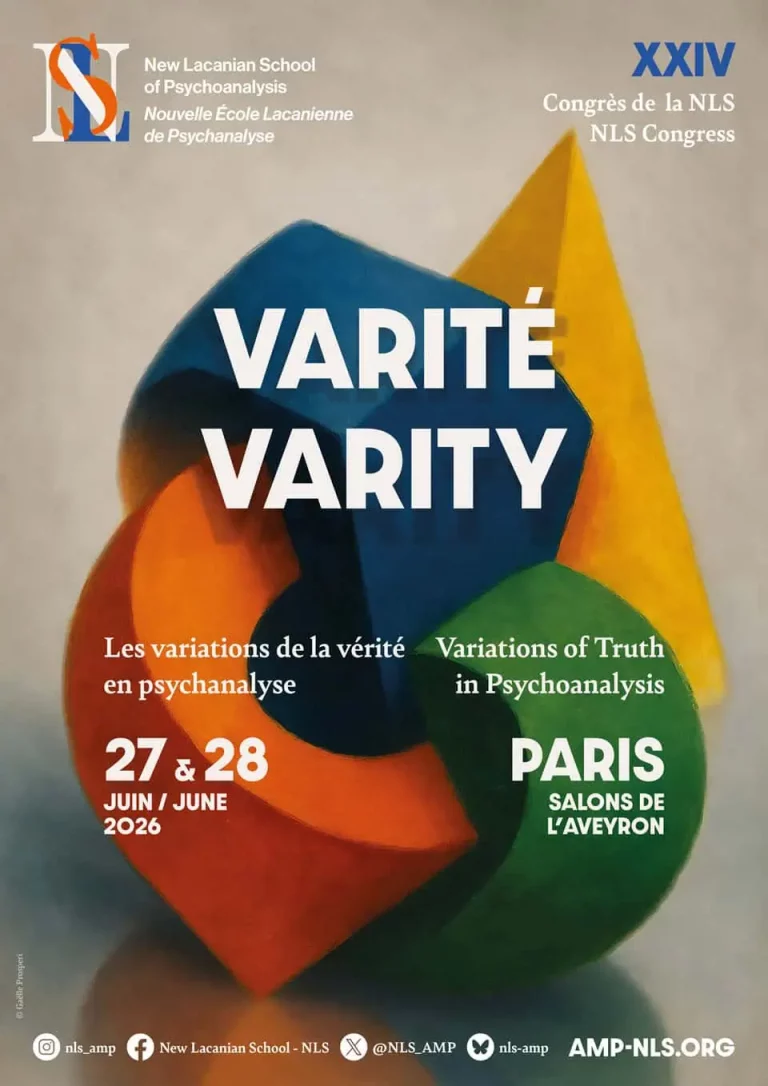
Truth in psychoanalysis does not coincide with what is said, nor with what can be fully known. From Freud to Lacan, truth appears as partial, emerging in what escapes speech: slips, repetitions, silences. With Lacan, truth is not conceived as unity but as varité, a plurality arising where language fails to close.
The film Father Mother Brother Sister[1] unfolds as three encounters between estranged family members. A father is briefly visited by his children; their exchange remains minimal, silences persist, and they leave without saying much. A mother hosts her daughters; beneath the staged setting, they whisper and conceal parts of their lives. Twins revisit their deceased parents’ apartment, moving through objects and traces of what was never spoken.
For Freud, truth is not what happened but how something is remembered and inscribed.[2] Lacan situates truth in speech: it emerges in the act of saying, divided and incomplete[3], always half-said, slipping away as soon as it is fixed.⁴[4]
The film renders this in the relations between its characters. Silence functions not as absence but as another mode of truth. Each subject speaks from a position marked by lack in the Symbolic, producing a singular truth that cannot coincide with that of the Other. It is precisely this non-coincidence that reveals the structure of their relation. What emerges is a series of incompatible versions, where truth appears only in fragments of speech.
At the same time, truth is often sacrificed to sustain the bond with the Other. What risks disrupting the fragile consistency of the relationship is displaced, softened, or left unspoken. Yet what is excluded returns in tension, repetition, symptom.
Psychoanalysis does not aim to unify these fragments; it stays with their divergence. Its ethics lies in sustaining this varité, allowing the subject to assume a divided truth bound to desire rather than to imaginary consistency.[5] Truth does not reconcile; it emerges precisely where speech falters and in what remains irreducibly unspoken.
- Jarmusch, I., (Director), (2025). Father Mother Brother Sister [Film]. Saint Laurent Productions; Badjetlag; CG Cinéma; The Apartment Pictures. ↑
- Freud, S., “Constructions in Analysis”, The Standard Edition of the Complete Psychological Works of Sigmund Freud, Vol. XXIII, trans. J. Strachey. London: Hogarth Press, 1937, pp. 257–269. ↑
- Lacan, J.,“Science and Truth”, Écrits, trans. B. Fink. New York/London: Norton., 2006, pp. 726–745. ↑
- Lacan, J.,“The Function and Field of Speech and Language in Psychoanalysis”, Écrits, trans. B. Fink.New York/London: Norton, 2006, pp. 197–268. ↑
- Miller, J.-A.,“The Unconscious and the Speaking Body”, Psychoanalytical Notebooks 6, 1999, pp. 13–29. ↑