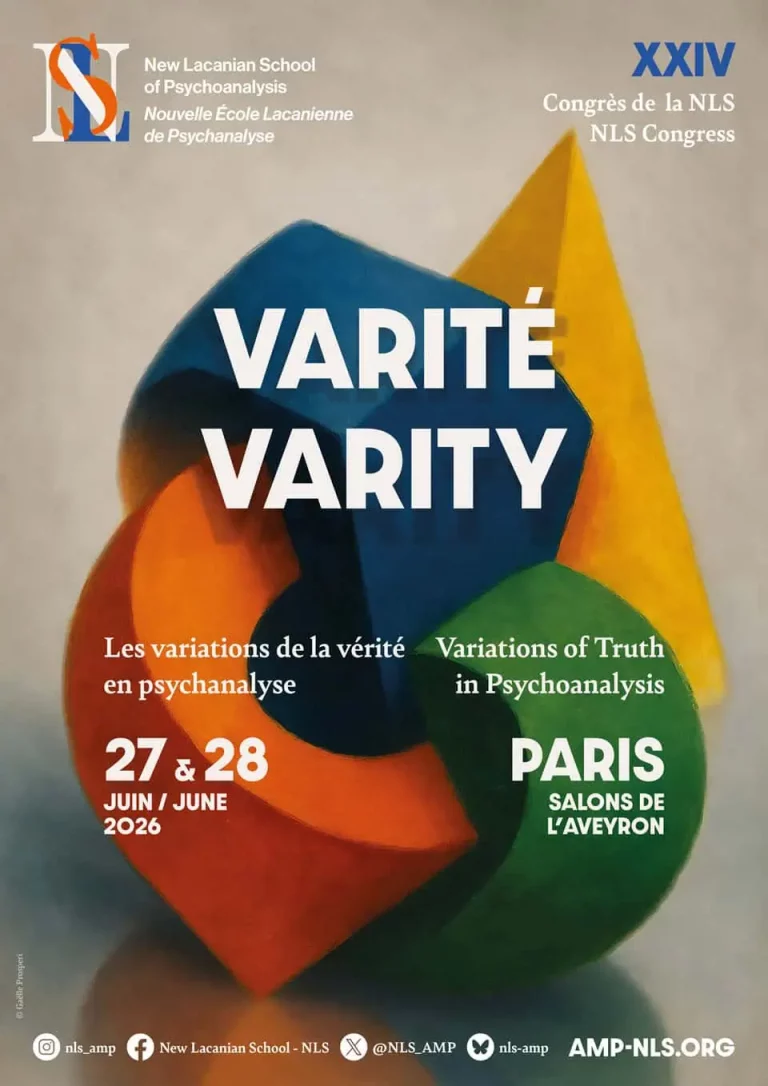
Varité — Les variations de la vérité en psychanalyse

Varité — Les variations de la vérité en psychanalyse

Varity and the Double Negative

By Tim Schokker

Varity — the variations of truth. Not that truth takes on different appearances while remaining fixed underneath. Variety names something more radical: truth is structurally not-whole. It cannot be said all at once. Every saying bends it. Lacan’s formulas of sexuation make this precise. The masculine side follows the rules of classical logic, where the existence of an exception (∃x⋅¬Φx — the primordial father) founds a stable, universal set (∀x⋅Φx). The feminine formula reads: ¬∃x⋅¬Φx — there is no x that does not fall under the phallic function.

A double negation. The classical logical interpretation treats this as eliminable: since classically ¬¬P=P, the formula reduces to a positive universal. This reading is wrong. Lacan says so explicitly: the pas-tout is his original contribution to logic, irreducible to any universal proposition. The correct reading is constructive. Arend Heyting, formalizing Brouwer’s intuitionism, made a fundamental distinction between singular and double negation. A singular negation (¬P) means that to prove P is impossible is to derive a contradiction from P — a reductio ad absurdum. For Heyting, a double negation (¬¬P) is thus the refutation of this impossibility: it establishes that P cannot be refuted. Double negation (¬¬P) then carries a structural asymmetry: while P→¬¬P holds universally, the reverse ¬¬P→P does not. To prove ¬¬P shows only that P cannot be ruled out. Crucially, no witness” is produced — no specific case or constructive proof that demonstrates P directly. No true statement is established. Lacan is explicit about this in Encore: As soon as you are dealing with an infinite set, you cannot posit that the not-whole implies the existence of something that is produced on the basis of a negation or contradiction. As we know from intuitionist mathematical logic, to posit a there is’ one must also be able to construct it.”¹ ¬∃x⋅¬Φx demonstrates that assuming a counterexample (¬Φx) leads to contradiction. It is a double negation that proves the impossibility of an exception, yet it fails to function as a constructive proof of a universal.

Nothing is built; the gap between ¬¬P and P remains open. This is where varity lives. As Lacan put it: truth can only be accessible through a half-saying (mi-dire), it cannot be said completely, for the reason that beyond this half there is nothing to say.”² Read constructively, this mi-dire is the only possible stance when facing a double negation. We do not half-say the truth because it is inaccessible; we half-say it because, logically, there is no whole” true statement to be found. Truth is not an object that exists prior to speech; it is the structural void that remains when the double negation fails to produce a true statement. Varity names the endless variations of a discourse that circles this gap. The analytic task is to let the analysand not not speak; it is to sustain this gap.

¹ Lacan, J., The Seminar of Jacques Lacan, Book XX: Encore, ed. J.-A. Miller, trans. B. Fink, New York/London: Norton, 1999, p. 103.

² Lacan, J., The Seminar of Jacques Lacan, Book XVII: The Other Side of Psychoanalysis, ed. J.-A. Miller, trans. R. Grigg, New York/London: Norton, 2007, p. 51.


Latest posts

Lastest texts

The Lightness of Doubt

Christina Sideri

The Lying Life of Adults

Maurien Caron

No truth without fiction in The Writer in the Family

Nina Todorova

The Half-Said Truth: Speech, Silence, and Varité

Eleftheria Elvanidi

The theme

towards the nls site

links