Dr. Gregory House is the protagonist of a popular TV series. He is named the “Medical Sherlock Holmes” due to his ability to solve complex cases by treating them as puzzles with a hidden truth. By focusing on rare and baffling illnesses and by applying unconventional methods, he gains insight through his elucubrations. What is interesting in his cases is the fact that he very often finds the solution because of slips of the tongue by his patients, or a significant but underestimated fact of their family story — something that has always been written. It is something of the register of trauma that at least at first sight does not fit the logic of the case but turns out to be the key to its successful solution.
The enigma of human suffering has always attracted interest. The approaches towards its elucidation are various, and psychoanalysis, being one of them, “is not concerned so much with transparency, which is clearly situated as a phenomenon of the imaginary, but rather with what is opaque.”[1] Contrary to the scientific method, which relies on the causal relation between trauma and symptom, psychoanalytical experience raises questions where something does not work. Freud questioned the truth in his patients’ words and “after long research, had finally given up on the believe in the objective reality of trauma.”[2] The impediment to finding out where their suffering comes from, along with his curiosity about femininity, made it possible for the central figure of the father to be outlined. “Everything indicates that Freud’s desire was retained in the oedipal logic”[3] but nevertheless, it is what psychoanalysis depends on[4]: The “Freudian unconscious is situated at that point, where, between cause and that which it affects, there is always something wrong.”[5]“Lacan’s desire went beyond the Oedipus”[6], it went beyond the universal myth, elucidating each subject’s own exclusion and touching the real. If Freud’s desire dwells in the oedipal logic while Lacan’s stretches toward the real of singular jouissance, where could we place the question of truth? From truth as fantasy to truth as an object, or even to truth as the empty place of that object, as a void.
- Svolos, T., Fake and Transparency. Orientation text of NLS Congress 2026. Available at: https://nlscongress2026.amp-nls.org/en/fake-and-transparency-en/fake-and-transparency/ ↑
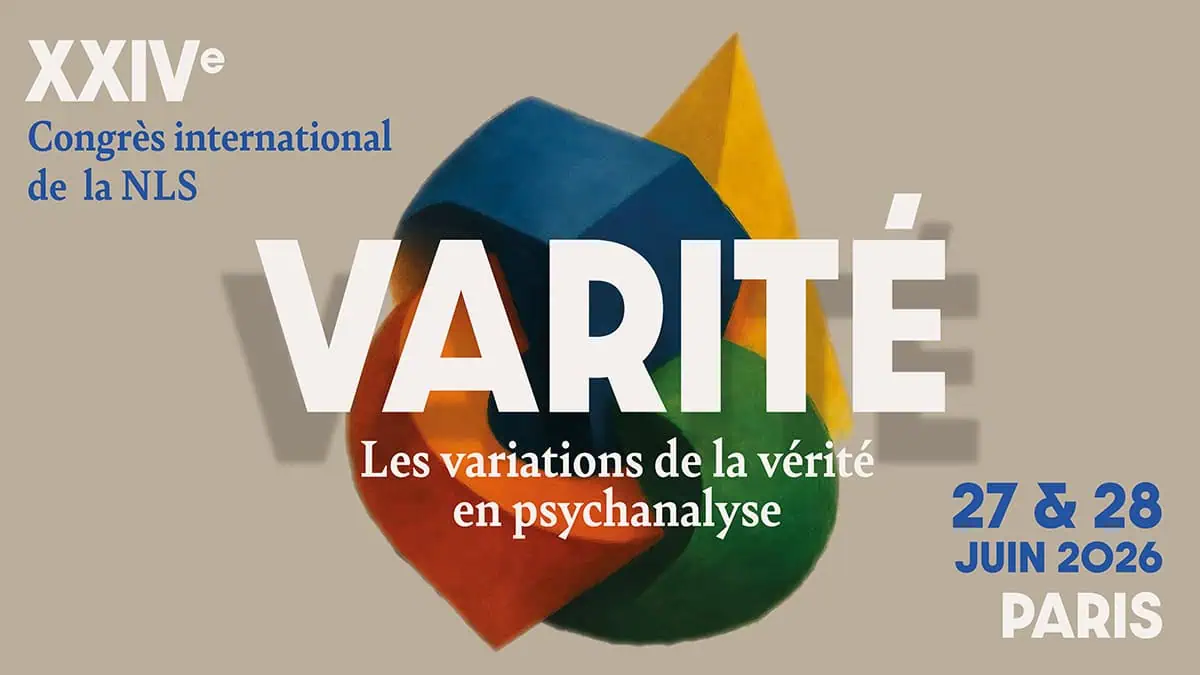
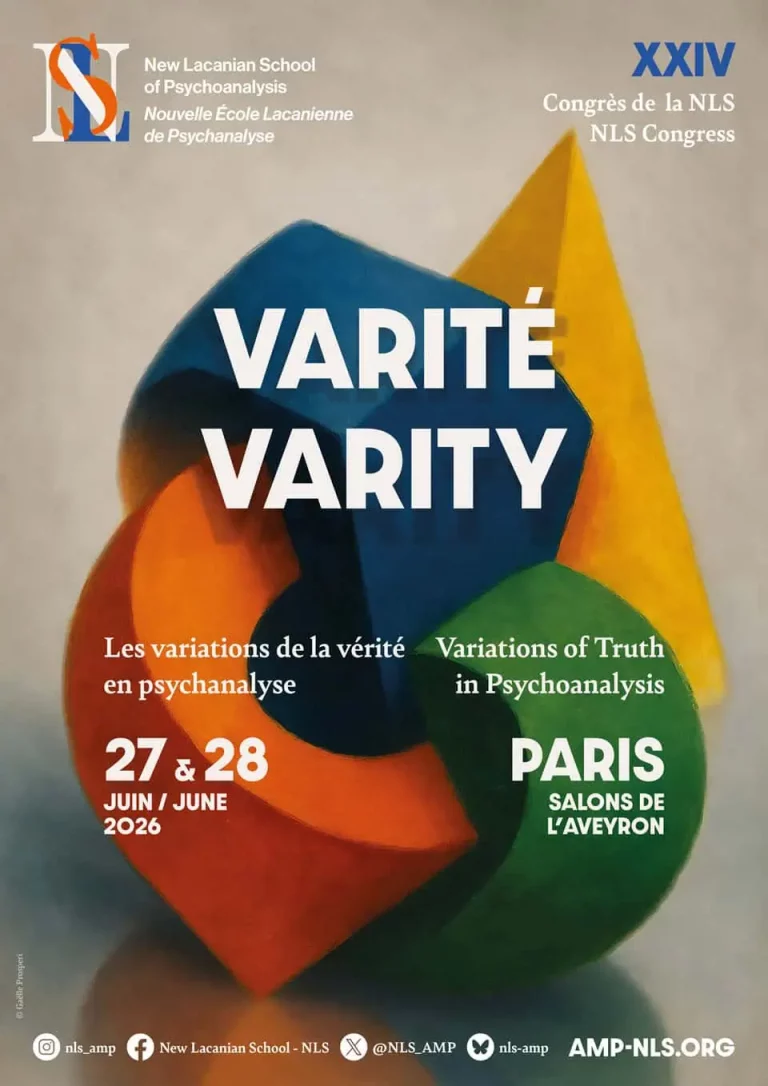
- Bosquin-Caroz, P., “Varity. Variations of Truth in Psychoanalysis” Presentation of the NLS Congress Theme 2026. Available at: https://www.amp-nls.org/wp-content/uploads/2025/07/ARGUMENT-NLS-CONGRESS-2026-PBC.pdf ↑
- Miller,J‑A., “The Turin Theory of the Subject of the School,” Psychoanalytical Notebooks 33, 2019, pp. 96–111. ↑
- Laurent, E., “The Pass and The Guarantee in The School”, Psychoanalytical Notebooks 2, 1999, p. 127. ↑
- Lacan, J., The Seminar of Jacques Lacan, Book XI: The Four Fundamental Concepts of Psychoanalysis, ed. J.-A. Miller, trans. A. Sheridan, New York/London: Norton, 1977, p. 22. ↑
- Miller, J.-A., “The Turin Theory of the Subject of the School,” op.cit. ↑