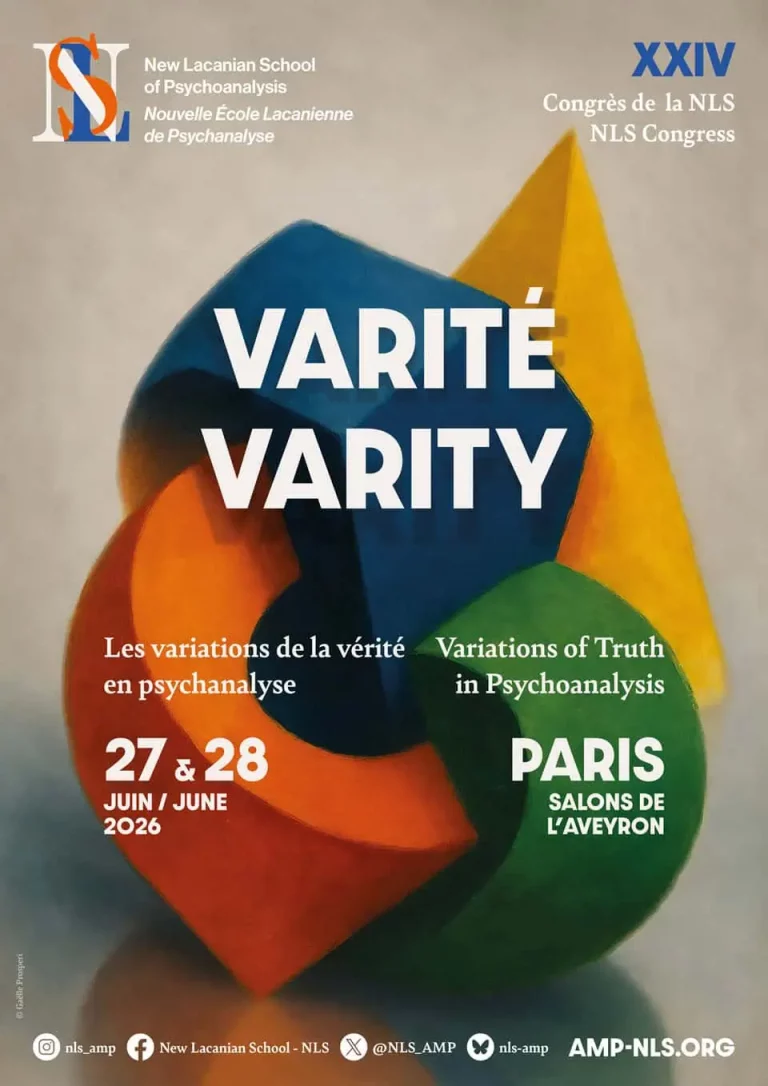
“Amicus Plato, sed magis amica veritas.”[1]
“Plato is my friend, but the truth is dearer to me.” Words attributed to Aristotle. But what is this “dearer truth” he speaks of? Is it the subjective truth of the one? The truth accepted by the majority? Or is it the truth in the interpretation we make when hearing the truth of another? The truth and nothing but .… Doesn’t this truth always have at least two sides? When two people look at а sign, one sees 6 and the other 9 — whose truth is dearer?
In Television, Lacan states that he always speaks only the truth, or at least that part of it that is possible to say.[2] This outlines two truths: the truth that can be said and the one that cannot. The latter slips along the edge of the Real and brings anxiety. The unspoken truth, not caught by the symbolic, hides in secrets, suspicions, doubts, and the symptoms of the body that express what slips away from language. It is there, on this edge, that anxiety awakens; there, the Real breaks through the veil with which the imaginary wraps it, there is the locus of anxiety.
The truth is also a choice to believe in what is chosen as Truth. In this sense, truth is an action and, as such, has a counteraction and direction. At the beginning of the conflict in Ukraine, a Russian journalist shared on his social networks the realisation of why his father continues to support the political regime despite the obvious truth about military actions. To admit that one believed a lie for so long is to admit to having spoken it and lied to more than just yourself. Admitting to being a liar is often unbearable. It is as if the truth has its own ethics: It changes and twists, but it always comes out naked from the well[3], and that is disturbing.
Isn’t the gaze what points out, captures, and exposes this truth which eludes words? Or does this same truth manage to slip away, hiding within the “spot” of the painting[4], in the blind spot?
At the beginning of Seminar XI, when discussing whether psychoanalysis is a science or leans towards religion, two words stand out: seek and find.[5] Science seeks truth – the truth of DNA or the truth that (after all) the Earth is round. Psychoanalysis finds truth – the subjective, personal, meaningful truth. This truth, which eludes language, makes the body speak through symptoms and triggers anxiety.
- Aristotle, 2014, Nicomachean Ethics, trans. R. Crisp, Ed, Cambridge University Press (original work, published ca. 350 B.C.E)., p. 11. ↑
- Lacan, J., Television, New York/London: Norton, 1990, p. 3. ↑
- Gérôme, J.-L., “Truth coming out of her well” [Painting], (1896), Musée Anne de Beaujeu, Moulins, France.. ↑
- Lacan, J., The Seminar of Jacques Lacan, Book XI: The Four Fundamental Concepts of Psychoanalysis, ed. J.-A. Miller, trans. A. Sheridan, New York/London: Norton, 1977, p.111. ↑
- Ibid. p.7. ↑