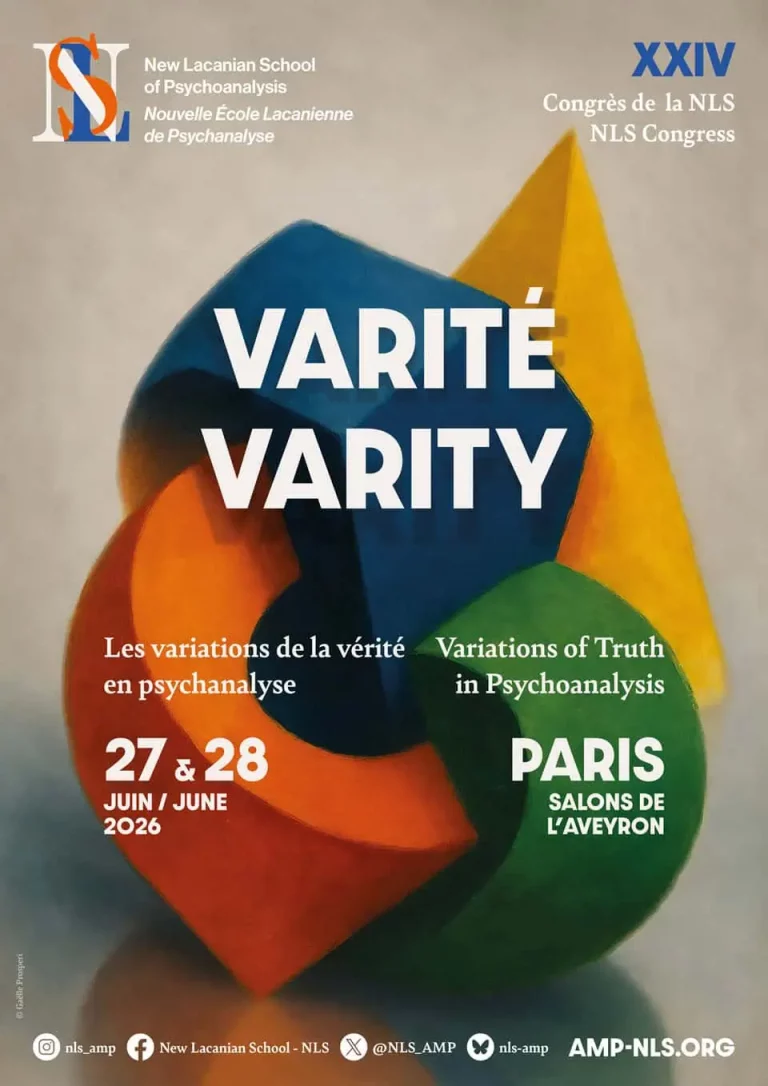

“This [Révélation] is the most natural word we have in French to designate the subject’s relation to a truth he accesses in a moment of seeing.”[1]
If there is revelation, repression preceded it. Something is unveiled. Analysis is a sequence of revelations, yet these truths vary.
In Love’s Labyrinths Miller writes: “Let’s start from the Freudian hypothesis that for every subject there is a fundamental lovable object [..] every subsequent object of love will be but a displacement of this fundamental object. We may write the fundamental lovable object as a”[2] (object cause). These are bits of desire that manifest in the form of an image related to a master signifier from our history. In French, love at first sight is called coup de foudre, a lightning strike. Freud describes it as the moment the subject instantly encounters the conditions of their love. What is that lightning strike if not a revelation?
Lacan says, “Psychoanalysis is what makes true, but how is making true to be understood? It’s a stroke of meaning, a sens blanc”[3] [blank meaning; homophonic with semblant]. In his later teaching, everything in the order of the symbolic and imaginary belongs to fiction. Against the narrative structured in analysis by those revelations is the disruption of the Real. There is an area where truth does not apply: jouissance. The later teaching shifts toward this Real in love too: the sexual non-rapport.
While desire has an inflexible meaning because it is determined by the object-cause, love, for Lacan, belongs to the side of “empty signification”,[4] where the object is substitutable, making it more exposed to indeterminacy and contingency.
Does real love exist? Marie-Hélène Brousse answers:
Imaginary love is the love at first sight, the arrow shot, where the other is less important because it is something of our imagination; Symbolic love was, for Freud, the love for the father; and then there is Real love, which is love without piety. It is a love that does not seek reciprocity and does not deceive itself; one knows the defects of the other but even so one loves them.[5]
With ‘piety’ (German: Pietät) in the sense of reverence, Brousse refers to a term Freud used in ‘A Disturbance of Memory on the Acropolis’ to describe the feeling that arose when he sensed he had gone beyond the (ideal) father.
For Brousse, Real love is situated beyond piety in the ideal, “whether that ideal belongs to the realm of images, fantasy, or symbols.” In this possibility of beyond lies the Real-ness of love: “I love: I want you to be” (Latin: Amo: Volo ut sis).[6]
- Miller, J.-A., “Truth is coupled with Meaning”, The Lacanian Review 2, 2016, p. 11 ↑
- Miller, J.-A., “Love’s Labyrinths”, Lacanian Ink 8 https://www.lacan.com/symptom16/love.html ↑
- Lacan, J., The Seminar of Jacques Lacan, Book XXIV: L’insu que sait…, lesson of May 10, unpublished. ↑
- Ibid, Lesson of March 15 ↑
- An interview by Sara Carreira with Marie-Helene Brousse in online journal Red Psicoanalítica “Real Love is Without Piety”. Available at: redpsicoanalitica.org/2016/03/13/marie-helene-brousse-sobre-el-amor/↑
- It is a well-known paraphrase of a passage by St. Augustine from Tractates on the First Epistle of John. The formulation was later used and popularised, most notably by Martin Heidegger in his correspondence with Hannah Arendt, and has since been cited by various philosophers and scholars. The original passage reads: “For what is love, except the will that what is loved should exist?” (trans. H. Browne). ↑