I Will Not Die While I’m Still Alive[1]
In the opening song of his remarkable new album, Asaf Avidan sings: “I’ve been too close to the darkness too long to not see the truth.” What is this truth?
In one interview Avidan suggests that art is, in a sense, always a lie, because it wraps infinity in order; yet it remains the closest to truth.[2] This recalls Lacan’s claim that truth has the structure of fiction, and that only through semblants can one approach the real. Art does not uncover a hidden truth but gives form to what cannot be said otherwise.
Echoes of Freud’s surprise in Delusions and Dreams in Jensen’s “Gradiva” [3], where the writer seemed to reach, through poetic creation, the logic of the unconscious which does not depend on the knowledge of analytic concepts.
Avidan’s lyrics exemplify this: “I will not die while I’m still alive.”; “I can’t breathe but I’m still spitting, and I don’t believe but I’m still spitting.”[4] Lines that can be read alongside Lacan’s Seminar VII: between two deaths, a paradoxical space opens in which desire persists, without guarantees.
Avidan’s truth is not certainty or revelation. It emerges from proximity to darkness, rejection, and deviation from the “normal trajectory” that ”only a song can try to explain.”
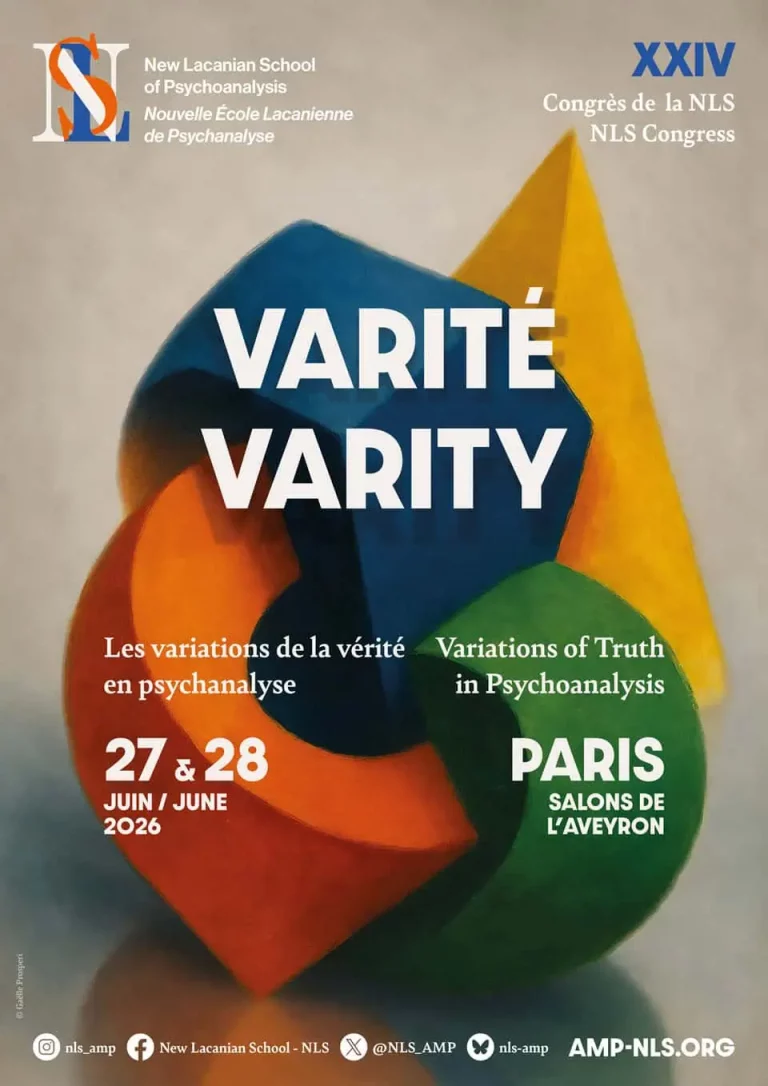
Lacan’s later definition of truth as discontinuous and fragmentary resonates here as Patricia Bosquin-Caroz notes[5]: “analytic discourse leads the analysand to […] a discontinuous history made up of scattered bits, fragments, emergences and revelations.” In Avidan’s work, this orientation appears in stylistic leaps, and in the imagery of the accompanying videos: not the restoration of a coherent narrative, but the staging of enunciations as fragments, repetitions, and cuts. Truth is not uncovered; it emerges in movement.
The album ends with “Unfurl,” where he sings: “…there’s a hole within me… all this song in me”, echoing perhaps Lacan’s poetic subjective rendering: “I am not a poet, but a poem. A poem that is being written, even if it looks like a subject.”[6]
- Avidan, A., 2025, “I Don’t Know When, I Don’t Know How, I Don’t Know Why”, Unfurl, Telmavar Records. See: https://www.youtube.com/watch?v=Er8_GHbpzSQ ↑
- Asaf Avidan, quoted in Maya Nahum Shachal, “I Told Brad Pitt I Had No Songs, He Said ‘Come’,” Calcalist (digital edition), December 2, 2025. See: https://www.calcalist.co.il/style/article/bj4yjfowwg (accessed January 13, 2026). ↑
- Freud, S., “Delusions and dreams in Jensen’s “Gradiva.” (1907). The Standard Edition of the Complete Psychological Works of Sigmund Freud, Vol. IX, London: Hogarth Press, 1959, pp. 1–95. ↑
- Here, “to spit” is used in contemporary slang (especially in rap and spoken-word culture) to mean to deliver words forcefully (“to spit bars”), that is, to keep speaking or voicing language even under pressure, rather than to spit literally. ↑
- Bosquin-Caroz, P., “Varity: Variations on Truth in Psychoanalysis.”, Presentation of the NLS Congress Theme 2026, p 7. Available at:https://www.amp-nls.org/wp-content/uploads/2025/07/ARGUMENT-NLS-CONGRESS-2026-PBC.pdf ↑
- Lacan, J. “Preface to the English Language Edition.” The Seminar of Jacques Lacan, Book XI: The Four Fundamental Concepts of Psychoanalysis, ed. J.-A. Miller, trans. A. Sheridan, New York/London: Norton,1977, p. vii. ↑