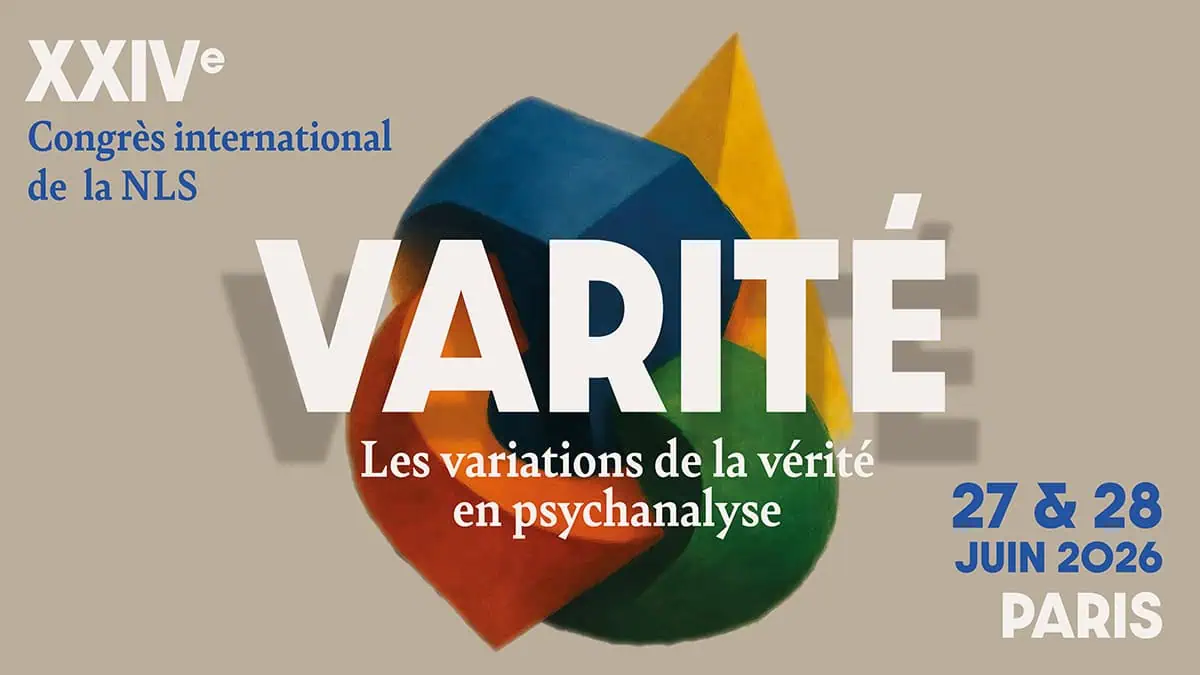
Varité — Les variations de la vérité en psychanalyse

Varité — Les variations de la vérité en psychanalyse

Fake and Transparency

By Thomas Svolos

These two words — fake and transparency — are not particularly our words, part of our psychoanalytic parlance. These are words, however, with a significant place in the social and cultural discourse around us. The notion of transparency is important for modernity and for capitalism and is concomitant with the rationalisation (and demystification or de-spiritualisation) that has been a part of the history of civilisation, for several centuries at least.

We can find the concept of transparency in a few places in Lacan’s work, and he situates it, in Seminar II, as a function of consciousness in Cartesian philosophy and thus fully aligned with modernity in the subjective domain.[1] In Lacan’s early readings of Freud’s cases, transparency is also attributed to the ego, to the domain of the imaginary — for example in the transparent screen of the ego” in Dora’s case[2] and in the transparency of the mirages of narcissism” in the Wolfman case.[3] Heading into the 1960s, Lacan introduces the binary opposition between transparency and opacity, where, in The Subversion of the Subject and the Dialectic of Desire, Lacan notes that “[t]he promotion of consciousness as essential to the subject in the historical aftermath of the Cartesian cogito is indicative, to my mind, of a misleading emphasis on the transparency of the I in action at the expense of the opacity of the signifier that determines it.”[4] This issue of a kind of visual apprehension of the unconscious can also be read in the great formulation of Lacan in Seminar XI regarding an unconscious that opens and closes — it is not transparent, but we can only catch glimpses (in unconscious formations) when the unconscious briefly opens up.[5]

The introduction of the binary, antonymic term of opacity” thus establishes an important orientation point in the psychoanalytic treatment. In the psychoanalytic experience, the analyst is not concerned so much with transparency, which is clearly situated as a phenomenon of the imaginary, but rather at what is opaque. This is figured in various ways in his work. Truth itself is certainly an early aim of analysis for Lacan, and is revealed in the analytic process, or uncovered, as Patricia Bosquin-Caroz demonstrated in her introduction to the Congress.[6] But, also, for the later Lacan, other terms will fill this place. In the text The Subversion …, as quoted above, it is the signifier,” which is of course the form that truth will take, at least for these moments in Lacan’s work. In the same article Lacan will also refer to the substance of desire” as opaque.[7] However, truth itself had already become a mirage in The Freudian Thing[8], and Lacan will eventually speak of the opaque place of jouissance of the Other” in Seminar XX.[9] Finally, Miller will reformulate this in Reading the Symptom as follows: to treat the symptom, you have to pass through the shifting dialectic of desire, but you also have to rid yourself of the mirages of truth. You have to rid yourself of the mirages of truth that this deciphering brings you and aim beyond at the fixity of jouissance and the opacity of the real.”[10] So, when it comes to truth, truth slips in Lacan’s work from the place of opacity to, in this binary, the place of transparency, we might even say.

Fake is another rare concept in psychoanalysis. Of course, the word is prominent today socially. In the United States, it is used most notably as an adjective in the description of the news media — fake news. The word carries interesting connotations — something made, constructed, as a fraud or counterfeit, and not the genuine or true thing. The interesting thing about fake is that, in some cases, the fact that it is not genuine is not disguised and is accepted either overtly or implicitly. Let me also add that the notion of the fake as a thing is interesting, because in reference to words or discourse, the usual modifier used to denote not true” would be false.” Fake would thus represent more a thing, something in the realm of being, than a word, something in the realm of discourse.

But, again, we don’t see this word very much in Lacan’s work. We do, however, have this concept that is quite close to fake, that of the semblant — which has this quality of make believe” and pretence that we associate with the fake. While this concept is not especially important in the earlier phases of Lacan’s work, it becomes quite critical in the semblantisation in the late Lacan,” according to Jacques-Alain Miller.[11] Many different concepts that had substance” earlier in Lacan’s work take on this quality of fake or semblant in late Lacan. The Phallus, for example, shifts from the status of object or signifier to semblant. The object a, which started out as a part object, a drive object, is, in Seminar XX, identified as a semblant of being.”[12] Even the Other itself, which, in The Subversion…, was the treasure trove of signifiers”[13] with a substantial quality, is itself a semblant in the last Lacan. And, the more classical psychoanalytic fakes, such as the veil and the masquerade that were important concepts for some analysts of Freud’s generation, all become refigured as a form of semblant.

In English, a classic antonym for fake is, of course, real. This binary has a very interesting resonance for us in Lacanian psychoanalysis, for it evokes the binary that served as the theme of the 2010 Congress of the World Association of Psychoanalysis: Semblants et sinthome. Where does truth fit in here for psychoanalysis? If we look at the first Lacan, the analytic process involves working through the fake imaginary to get to the truth, but, at the end of analysis, the analyst works through the semblant of truth to get to the sinthome (of course, there is not really another way, we must add, than going through truth).

This shift is, without doubt, linked to not only a semblantisation in psychoanalysis, but a semblantisation in civilisation itself. What once seemed real or substantial or objective is seen now as but a semblant. Take something as objective seeming as Newton’s Laws” in physics. Centuries ago, these laws served without doubt to explain the motion of bodies in the world around us and were not propositions, but laws. They had a real and objective function in describing, representing, and predicting the world. However, with the physics of Einstein, we come to grasp that they are not true,” in that they do not describe the action of all physical bodies, physical bodies in the more expansive realms of space and time that we had not yet discovered at the time of Newton (the very small, quantum particles, or the very large, cosmic bodies). In that sense, these true laws now are semblants: certainly not without a use, but not the whole truth.

  1. Lacan, J., The Seminar of Jacques Lacan, Book II: The Ego in Freud’s Theory and in the Technique of Psychoanalysis, ed. J.-A. Miller, trans. J. Forrester, Cambridge: Cambridge University Press, 1988, p. 6.
  2. Lacan, J. Presentation on Transference”, Écrits, trans. B. Fink, New York/London: Norton, 2006, p. 184.
  3. Lacan, J. Variations on the Standard Treatment”, Écrits, op.cit., p. 292.
  4. Lacan, J. The Subversion of the Subject and the Dialectic of Desire”, op.cit., p. 685.
  5. Jacques Lacan, The Seminar of Jacques Lacan, Book XI: The Four Fundamental Concepts of Psychoanalysis, ed. J.-A. Miller, trans. A. Sheridan, New York: Norton, 1977, p. 43.
  6. Bosquin-Caroz, P., VARITY: Variations of Truth in Psychoanalysis.” Accessed on October 15, 2025, at https://www.amp-nls.org/wp-content/uploads/2025/07/ARGUMENT-NLS-CONGRESS-2026-PBC‑1.pdf
  7. Lacan, J. The Subversion of the Subject and the Dialectic of Desire”, Écrits,op.cit., p. 689.
  8. Lacan, J. The Freudian Thing”, Écrits, op.cit., p. 340.
  9. Lacan, J., The Seminar of Jacques Lacan, Book XX: Encore, ed. J.-A. Miller, trans. B. Fink, New York, W. W. Norton, 1998, p. 82.
  10. Miller, J.-A., Reading a Symptom,” Hurly-Burly 6, 2011, p. 152.
  11. Miller, J.-A., Semblants et sinthome,” la Cause Freudienne 69, 2008, pp. 124–131.
  12. Lacan, J., The Seminar of Jacques Lacan, Book XX: Encore, ed. J.-A. Miller, trans. B. Fink, New York, W. W. Norton, 1998, p. 90.
  13. Lacan, J. The Subversion of the Subject and the Dialectic of Desire”, Écrits, op.cit., p. 692.

Latest posts

Lastest texts

Knowledge: The True, the False, and Beyond — the Truth Reintroduced by Psychoanalysis

Panagiotis Kosmopoulos

History, Myth, Fiction

Dossia Avdelidi

Woman and Truth?

Natalie Wülfing

The theme

towards the nls site

links