

In his Project for a Scientific Psychology[1] Freud presents Emma, under the heading of Hysterical proton pseudos,[2] to clarify his thinking. What is the first lie?
Emma is “subject to a compulsion of not being able to go into shops alone.” She remembers that, when she was twelve years old, she went into a shop and saw two shop assistants laughing. She ran away in an “affect of fright.” Why? She thought they were laughing at her clothes. Oddly, she adds that one of them had “pleased her sexually.” In what way does this constitute the first lie?
Neither the fragments nor the effect of the experience make sense to Freud. The idea of her clothes doesn’t explain why she can’t go into a shop alone. And why does she say that one of the shop assistants pleases her sexually? Further questions bring a second memory that had not been in her mind during the moment described in this scene. When she was eight years old, she had gone into a shop to buy sweets: the grinning shopkeeper had grabbed at her genitals through her clothes. She had returned a second time, she couldn’t understand why. She reproaches herself with bad conscience.
She makes an “associative link” between the two scenes: the “laughing” shop assistants reminded her of the “grinning” shopkeeper. Freud deduces something else. The earlier scene was lived before puberty and was invoked after puberty. The earlier scene retrospectively gets a sexual charge during the second scene. This quantity of energy is transformed into anxiety, providing the motor discharge to propel Emma out of the shop.
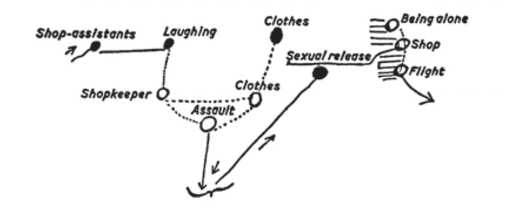
Freud draws a schema to show how her words relate to each other and emerge into consciousness via her perceptions and memories. This writing allows him to see how the most innocent idea, “clothes,” represents the whole unconscious complex: repression accompanied by a symbol-formation (“clothes”) has taken place. Energy, arising from within the body and cut off from its original representations, is used to form the symbol. This writing is the first lie! It is made in the unconscious by an energetic agency seeking a more acceptable representative or symbol, the first one having been repressed. The outcome of this process is the “quite rationally constructed” symptom in which the newly formed symbol, “clothes,” plays no part and passes into consciousness. This is the peculiarity of the case. The repressed memory becomes the trauma of sexual desire through the deferred action after puberty (“the shop assistant was sexually pleasing to me”). Freud’s pen on the page renders these ideas sensible; his belief in a sexual energy caps it.
- Freud, S., “Project for a Scientific Psychology” (1950), The Standard Edition of the Complete Psychological Works of Sigmund Freud, Volume I, London: Hogarth Press, 1966, pp. 353–356. ↑
- An idea found in Aristotle: “first falsity,” or “first lie.” ↑