What it means to “send a word” has changed over the course of civilization. How is it different to write a letter than to send a message via social media?
The sending of a letter bears the mark of boundaries. There’s distance that can’t be ignored. Today, instant notifications alert whether a message is delivered, and with it certain aspects of the gaze of the other appear; being ‘left unseen’ may translate as rudeness and abandonment. Sending words is no longer limited, and the other body is impacted immediately.
There are two forms of writing. Sending a word today is no longer addressed, to be read, to create meaning. Lacan states that “the written, is in no way in the same register… as the signifier.”[1] Today it concerns writing as a pure mark, devoid of meaning.[2] This form of writing, produces an event in the body, and inscribes a mode of jouissance.
Lalangue is what will become language, when it passes through the Other. “But does lalangue serve, first and foremost, to dialogue? … nothing is less certain.”[3] It serves jouissance. Is it not the circulation of language that operates in contemporary online writing, but the circulation of lalangue?
Social bonds serve as an attempt to tell a bit of the truth about idiotic jouissance of the One. A story online only ‘lasts’ for 24 hours, and then disappears, only to reappear once every year through the platform’s memory function — bits of jouissance, telling the truth of the here-and-now, which are being thrown in the imaginary as objects for others to enjoy. And if “truth can only be attained through the others”[4], then what truth is the one spoken not like a language, but rather like a lalangue?
“Lacan thus mentions another register in which truth is no longer relevant, except as lying: that of jouissance and its satisfaction. The lying truth then becomes an elucubration of knowledge about the real, which does not prevent effects of truth from occurring and the analyst being attentive to them.”[5]
Sending a word is also demand of speech, and as such “calls for a response…provided it has an auditor”.[6]’ Psychoanalysis can provide space for an auditor to be present, but will speaking beings give up their comfortable solitude, and agree to bear with the mark of language?
- Lacan, J., The Seminar of Jacques Lacan, Book XX: On Feminine Sexuality, the Limits of Love and Knowledge, ed. J.-A. Miller, trans. Bruce Fink, New York/London: Norton, 1999, p. 29. ↑
- Lacan, J., « Lituraterre », Littérature, n° 3, Octobre 1971, éd. Larousse, pp 3–10. ↑
- Lacan, J., The Seminar of Jacques Lacan, Book XX: On Feminine Sexuality, op.cit. p. 138. ↑
- Laurent, É., “Alienation and Separation (I),” Reading Seminar XI: Lacan’s Four Fundamental Concepts of Psychoanalysis, eds. R. Feldstein, B. Fink, M. Jaanus, Albany: State University of New York Press, 1995, p. 23. ↑
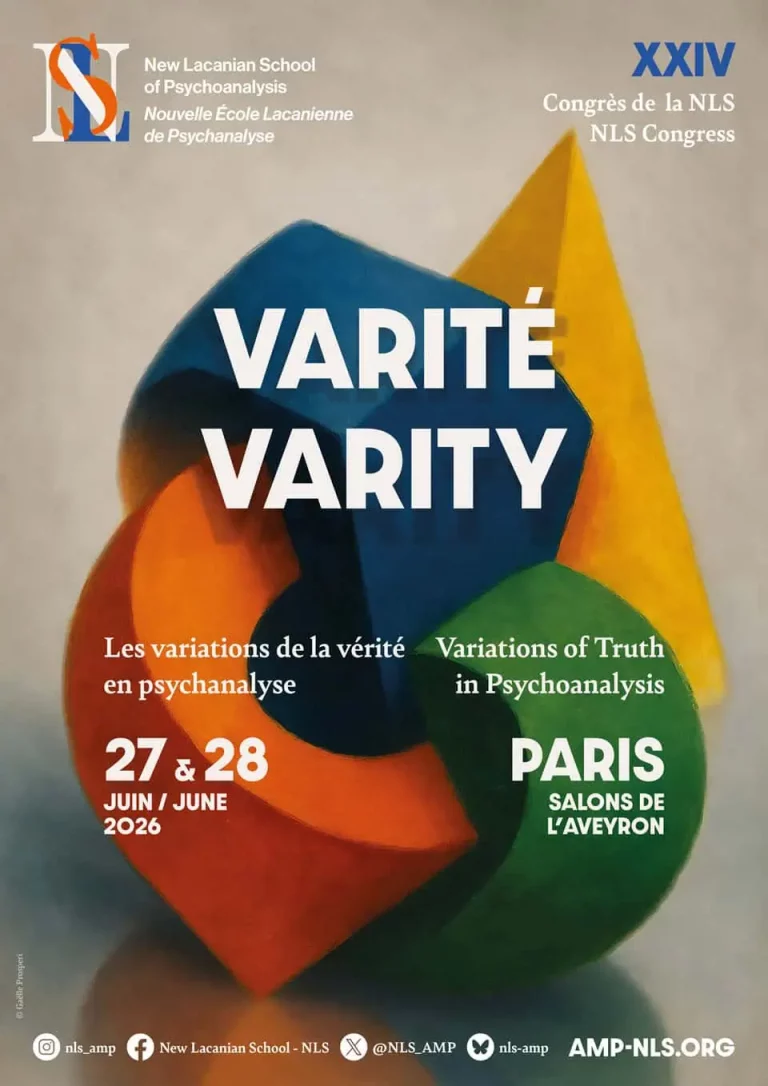
- Patricia Bosquin-Caroz, ‘VARITY: Variations of Truth in Psychoanalysis”. Presentation of the NLS Congress Theme 2026. Available at: https://www.amp-nls.org/wp-content/uploads/2025/07/ARGUMENT-NLS-CONGRESS-2026-PBC.pdf ↑
- Lacan, J., “The Function and Field of Speech and Language in Psychoanalysis,” Écrits, trans. B. Fink, New York/London: Norton, 2006, p. 206. ↑